The Problem: One Supply Is One Point Of Failure
An off-grid cabin near Thurso needed a power solution that didn't rest on a single fixed installation — something that could combine several sources and, unusually, be moved if it had to be.
Most off-grid systems are built around one dominant source with the rest as afterthoughts. That works until the dominant source has a bad month. In the far north, solar has a very bad few months: output collapses through midwinter at precisely the point when the lights are on longest.
The portability requirement was the more unusual ask. Permanent installations assume the site is settled — that the building, the layout and the intended use won't change. That assumption isn't always safe, and it's an expensive one to get wrong when the entire system is fixed to a wall.
Multi-Source By Design, Not By Accretion
The system was built from the start to accept input from three sources: solar, a 1.5kW wind turbine, and a generator.
Each source gets its own input and charge control, and all of them charge the same battery bank. The inverter then draws from that battery without caring where the energy originated. It's a simple architecture, and its value is that the sources cover each other's weaknesses rather than duplicating each other's strengths.
- Solar — strong through the long northern summer days, minimal in deep winter
- Wind (1.5kW) — strongest in the winter months when solar is at its worst, on a site exposed enough to make it worthwhile
- Generator — the backstop for still, dark periods when neither renewable source is delivering
Why solar and wind belong together this far north: they're complementary rather than competing. The days with the least sun are frequently the windiest, and pairing them cuts how much generator running — and fuel — the site actually needs.
What's inside the cabinet
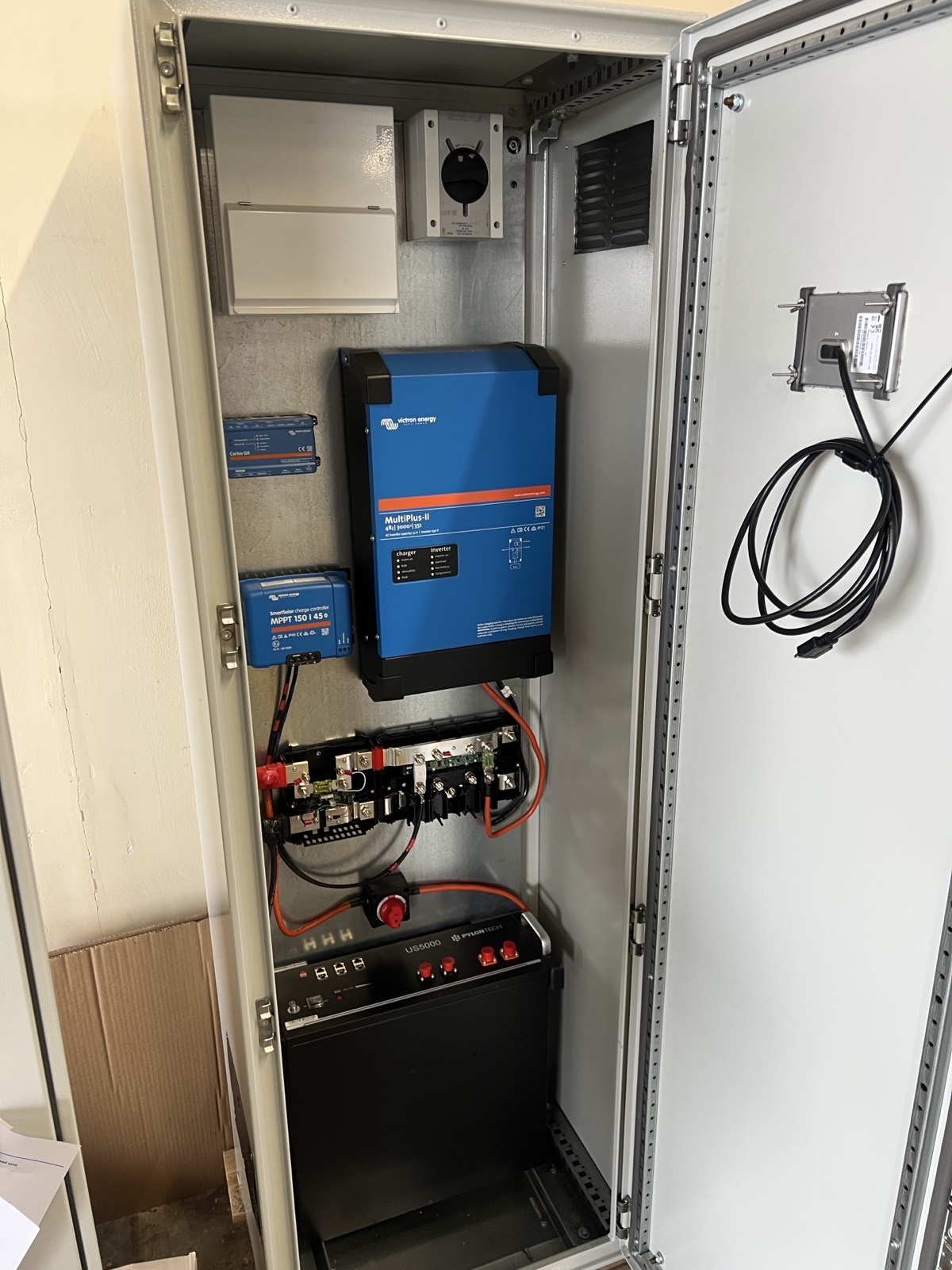
The core is a Victron MultiPlus-II 48/3000 inverter-charger paired with 5kWh of Pylontech battery storage. Around that:
- Victron SmartSolar MPPT 150/45 charge controller, managing the renewable input into the battery
- Victron Cerbo GX for system monitoring — so the state of charge, the sources and the loads can be seen rather than guessed at
- Properly arranged busbars, fusing and DC isolation, laid out to be worked on rather than squeezed in
- An AC distribution enclosure and rotary isolator within the same cabinet
The Cerbo is worth dwelling on. On an off-grid site with three input sources, the question isn't just whether there's power — it's which source is doing the work, whether the battery is recovering, and whether the generator is running more than it should be. Monitoring turns that from guesswork into information, which is what lets a system be managed rather than merely owned.
For a cabin running lighting, charging, refrigeration and normal small appliances, 5kWh is a comfortable day of use with margin in hand. Being straight about what it isn't: this isn't sized for electric heating, an immersion heater or an electric hob, and it was never intended to be. Sizing starts from what the property will genuinely run, not from a headline figure that looks reassuring on paper.
Built For Exposure
The whole system sits in a sealed, waterproof steel enclosure built to handle exposed outdoor conditions — which, on the north coast of Caithness, is not a theoretical requirement.
Building it as a self-contained unit brings advantages beyond weather protection:
- Assembled and tested as a unit, rather than improvised in position on site
- No need for a suitable dry indoor room to give up to plant
- Everything in one place, which makes servicing and fault-finding straightforward rather than a hunt
- Protected as a whole from weather, dust and interference
And It Isn't Tied To One Spot
Critically, the unit was built to be portable. It isn't permanently fixed to one position on the site.
That's a genuinely useful property, and it's rare. It means the power system isn't a constraint on how the site develops — if the cabin's use changes, if a better position emerges, or if the setup needs to serve somewhere else entirely, the system goes with it. Nothing has to be decommissioned and rebuilt to make that possible.
The Outcome
The cabin runs on a flexible, self-contained power system that draws from whichever source is available — sun, wind or generator — commissioned and fully operational.
It has real multi-source resilience rather than a single supply with hopeful backup, it's protected against genuinely hostile weather, and it can be relocated if the site's needs change. For an exposed off-grid site in the far north, that combination is worth considerably more than a larger system that could only ever live in one place.
Some sites don't have a standard answer. Multiple sources, no plant room, hostile weather and an uncertain future layout is not a specification you can order off a shelf — it's a design problem. Being able to build the solution rather than only install one is the difference.
Common questions
Can solar, wind and a generator all feed the same off-grid system?
Yes, and on an exposed site it's usually the right approach. Each source is handled by its own charge controller or input, and they all charge the same battery bank — the inverter then draws from that battery regardless of where the energy came from. The benefit is that the sources cover each other: the days with least sun in a Scottish winter are frequently the windiest, and the generator covers the periods when neither delivers.
How much power does 5kWh of battery storage actually give you?
For a cabin running lighting, charging, a fridge and normal small appliances, 5kWh is a comfortable day of use with margin. It isn't sized for electric heating, an immersion heater or an electric hob, which would exhaust it quickly. The useful figure is always what you intend to run rather than the headline capacity — which is why sizing starts with a conversation about actual loads.
Why build a power system into a cabinet rather than install it in a building?
A sealed cabinet means the system is protected as a single unit, pre-built and tested rather than assembled in place, and it doesn't need a suitable dry room to live in. It also means everything is together, which makes servicing and fault-finding far simpler. On a site with no obvious plant room — or where the layout may change — it's often the more sensible answer.
Is a wind turbine worth adding alongside solar in northern Scotland?
On an exposed northern site, frequently yes. Solar output in the far north drops sharply in midwinter, exactly when demand for lighting is highest, whereas wind tends to be strongest through those same months. The two are complementary rather than competing, and pairing them reduces how much generator running you need to fall back on.