When You Generate Your Own Power, Nobody Else Is Watching It
On the grid, someone else owns the problem. Your supply is somebody's job, faults get noticed by a network operator, and a power cut ends when an engineer you never meet fixes something you never see.
Off-grid, all of that is yours. There is no operator monitoring your supply, no automatic fault reporting, and nobody whose responsibility it is to spot that something has quietly started to fail. The only warning you get is the one you go looking for.
That is what makes servicing different for remote and off-grid properties. It isn't routine maintenance on a convenience — it's the only mechanism that tells you whether the thing your house depends on is still up to the job.
Backup equipment fails silently. A standby generator spends nearly all its life switched off, which is precisely why a developing fault goes unnoticed. Nothing announces that it has stopped being reliable. You find out at the exact moment you needed it to work.
The pattern we see repeatedly: a system installed properly years ago, never looked at since, on a site where getting someone out at short notice is difficult and expensive. Nothing was neglected deliberately. There was simply never a prompt.
Three Things We Do
Annual Generator Servicing Contracts
Scheduled annual servicing for domestic and off-grid generators — so the visit happens because it's booked, not because someone remembered.
Domestic standby sets and off-grid primary sets get looked at differently, because they're doing different jobs. A standby generator needs to be certain to start after months of sitting idle. A primary set is running real hours and wearing accordingly. Same discipline, different emphasis.
We service equipment we didn't install. That includes legacy plant, obsolete models, and machines that other firms have declined to quote on. If you've taken on a property and have no idea what's sitting in the outbuilding, that's a normal starting point — not an awkward one.
Generator Repairs
Generators that won't start, won't hold load, or have simply stopped being trusted.
The first job is an honest diagnosis, because "it doesn't work" covers everything from a fuel problem to a failed alternator, and those are very different conversations. A non-runner is far more often a fuel, starting or control fault than a dead engine — which means repair is frequently the sensible answer, at a fraction of replacement cost.
Where a set genuinely is beyond economic repair, we'll say so plainly. What we won't do is push a replacement because it's the easier sale.
Electrical Periodic Inspection & BS 7671 Compliance
Periodic inspection and testing of fixed electrical installations against BS 7671, with an EICR issued on completion.
An installation that was compliant when it was certified doesn't stay that way indefinitely. Connections loosen, insulation degrades, alterations get made by someone in a hurry, and moisture and rodents do their work — all of which is more pronounced in rural buildings, steadings and outbuildings than in a centrally heated house.
An EICR gives you a documented position on what's safe, what's deteriorating and what needs attention — which is what insurers, letting agents and buyers ask for, and what you need before problems become dangerous rather than merely expensive.
What a service visit includes
Exact scope depends on the equipment, but a generator service visit covers:
- Engine inspection — fluids, filters, belts, general condition and wear against what that set should look like at its age and hours
- Starting and control systems — tested deliberately, never taken on trust, since nothing else matters if the set won't fire
- Running test under load, not just a start-up on no load
- Fuel system, tank condition and, where fitted, long-run supply arrangements
- Electrical connections, changeover or transfer switch operation, and the distribution the set feeds
- A clear written account of condition, anything developing, and what we'd recommend doing about it
The last point matters as much as the practical work. You should finish a service visit knowing more about your system than you did before — not just holding an invoice.
What This Looks Like In Practice
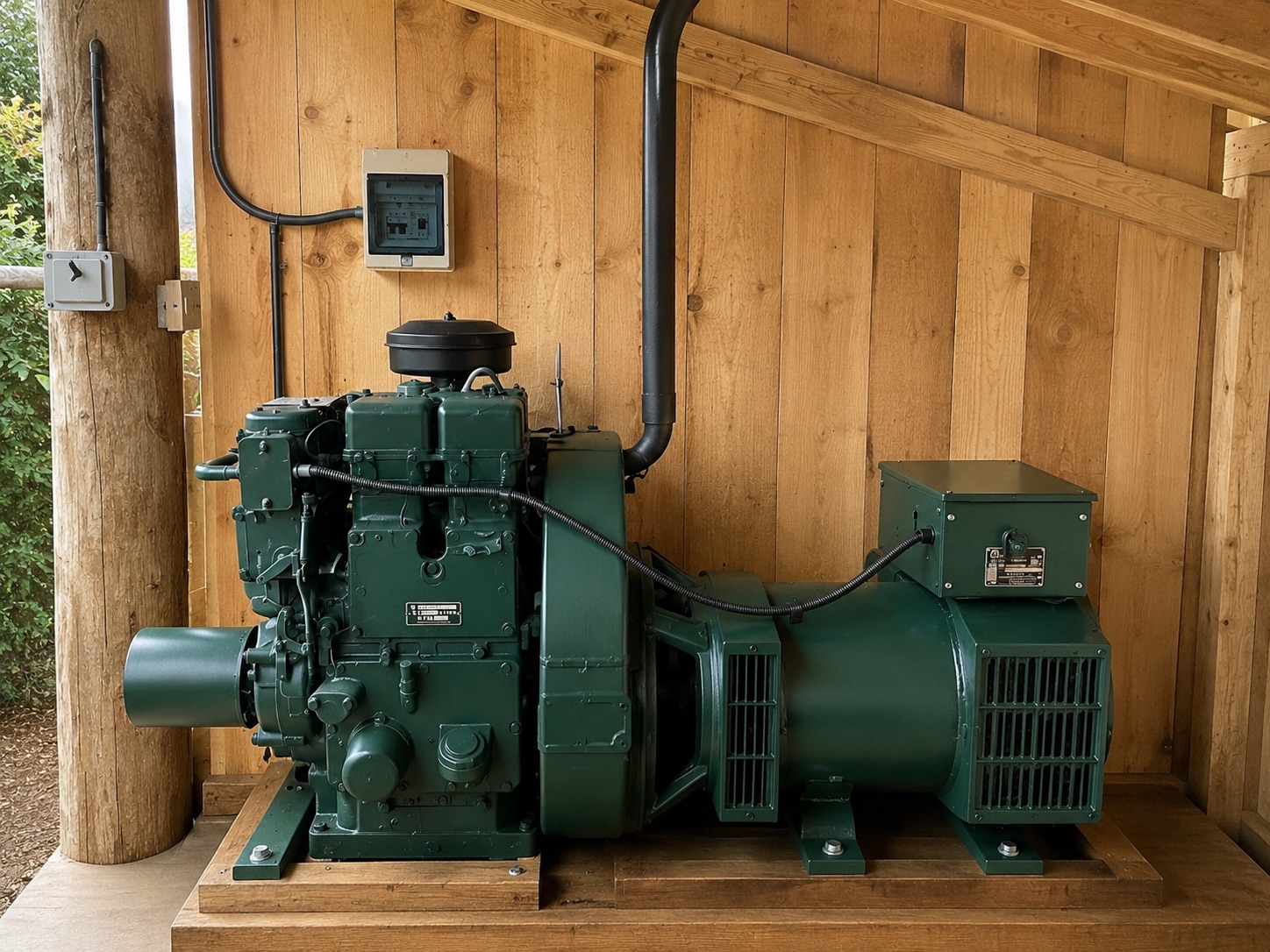
Keeping a Classic Lister Running — Estate Backup Generator
Decades-old plant, an obsolete auto-start arrangement, no parts catalogue and nobody to escalate to. We hold it on a yearly schedule and give it the same rigour a new installation would get — because the estate's power depends on it, and that doesn't change with the date on the plate.
Read the case studyThat job is the clearest illustration of how we work: we service what we didn't necessarily install, including genuinely old equipment. Where there's no vendor behind a machine, the diligence has to come from whoever maintains it. That's the job.
Further examples
Right-sized, well-maintained, and honest about what you need. Those two jobs and the Lister are the same principle from different directions — specify what's actually required, keep it in proper order, and tell the customer the truth about both.
Common questions
Do I need a servicing contract, or can I book a one-off visit?
Either. A one-off visit is the right starting point if you've inherited a system, bought a property with a generator already installed, or simply don't know what condition things are in. An annual contract makes more sense once you know what you have — because it means the visit gets scheduled rather than remembered, and on a remote site that difference is the whole point.
What is an EICR, and how often does my property need one?
An Electrical Installation Condition Report is a formal inspection and test of a fixed electrical installation against BS 7671, recording anything unsafe or non-compliant. Typical intervals are every ten years for an owner-occupied home, every five years for rented property, and commonly every five years or at change of occupancy for commercial premises. Insurers and letting agents will often ask for one regardless of when the last was done.
Will you service properties on islands and in very remote locations?
Yes. Remote and island properties are the ones that benefit most from planned servicing, because they're the hardest to reach in an emergency and the most exposed when power fails. We plan visits around access, ferries and weather — and we'd rather make a scheduled trip than an emergency one.
What happens if you find a fault during a service visit?
We tell you what we've found, how serious it is, and what it'll cost to put right, before doing any additional work. Minor items we can usually deal with on the visit. Anything larger gets quoted so you can decide. What we won't do is carry out extra work you haven't agreed to and present it afterwards.